
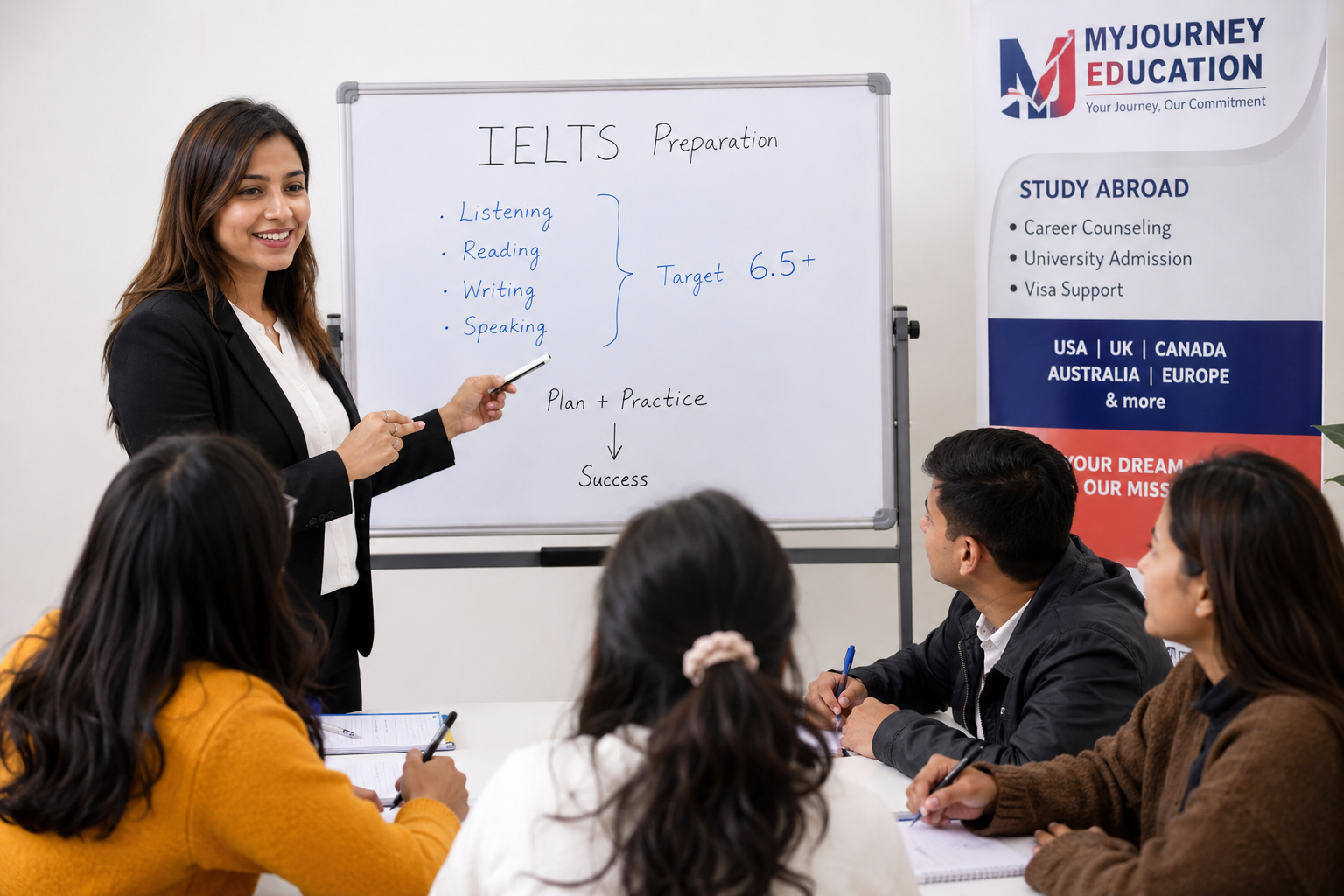
If you are planning to study abroad, apply for migration, or improve your English language qualification, IELTS is probably one of the first things you have started thinking about.
Every year, thousands of students in Kathmandu join IELTS preparation classes. Some want to achieve a 6.0 or 6.5 band score, while others aim for 7.0, 7.5 or even higher. But one common question remains:

How should I actually start my IELTS preparation?
Joining an IELTS class is easy. Choosing the right instructor, understanding your current level, preparing according to your target score, and practicing consistently are the parts that really matter.
As an IELTS instructor, I always recommend students to understand their own requirements before joining a class. IELTS preparation should not simply be about attending classes every morning or evening. It should be a structured process where you understand the test, identify your weaknesses, practice regularly, and receive proper feedback.
If you are looking for IELTS classes in Kathmandu, here is a practical way to start.
First, Understand Why You Need IELTS
Before joining an IELTS preparation class, be clear about why you are taking the test.
Are you preparing for:
- Study abroad?
- Australian, Canadian, UK, or other university admission?
- Migration?
- Professional registration?
- Scholarship applications?
- General English improvement?
Your purpose can influence the type of IELTS preparation you need.
For example, a student applying to a university may have a particular overall band requirement as well as individual requirements in Listening, Reading, Writing, and Speaking.
Therefore, don’t start your preparation simply because your friends are studying IELTS. Start because you know what score you need and when you need it.
Take an IELTS Assessment Before Starting
One of the biggest mistakes students make is joining an IELTS class without knowing their current English level.
Before starting a full preparation course, take an initial assessment.
Your assessment should ideally look at all four IELTS modules:
Listening, Reading, Writing, and Speaking.
You may discover that your Listening and Reading are already quite strong, but your Writing needs significant improvement. Another student may have good grammar but struggle with Speaking fluency.
This is why I always recommend students to identify their weaknesses before creating a preparation plan.
An initial assessment gives you a starting point.
Choose the Right IELTS Instructor
There are many IELTS institutes and instructors in Kathmandu. However, the right instructor is not necessarily the one making the biggest promises.
Be careful with claims such as:
“Guaranteed 8 band.”
“100% success.”
“Questions will definitely come from our prediction.”
IELTS is an international English language test. Nobody can honestly guarantee the exact questions you will receive or promise a particular band score without considering your actual performance.
A good IELTS instructor should instead help you understand:
- How the IELTS test works
- What examiners look for
- Where you are losing marks
- How to improve your vocabulary naturally
- How to organize your Writing answers
- How to develop Speaking fluency
- How to manage your time
- How to practice effectively at home
For me, IELTS teaching is not simply about completing a textbook. It is about helping students understand why their answer is weak and how they can make it better.
IELTS Writing Needs Special Attention
Many students in Kathmandu are comfortable with Reading and Listening but become nervous when they reach Writing.
IELTS Writing requires more than knowing English vocabulary.
You need to understand:
- Task response
- Coherence and cohesion
- Vocabulary
- Grammar
- Paragraph development
- Ideas and examples
- Sentence structure
A student may know many difficult words but still receive a lower score if the ideas are poorly organized.
That is why I recommend writing regularly during IELTS preparation.
Don’t wait until the final week before your examination to start writing essays.
Write.
Get feedback.
Understand your mistakes.
Rewrite.
Repeat.
That process is much more useful than memorizing a large number of complicated words.
Speaking Practice Should Be Regular
Speaking is another area where students often need guidance.
Some students understand English well but become nervous when they have to speak in front of another person. Others know what they want to say but struggle to organize their thoughts quickly.
The solution is regular practice.
You should become comfortable speaking about everyday topics, personal experiences, opinions, education, technology, society, work, travel, and other common areas.
However, IELTS Speaking preparation should not mean memorizing complete answers.
Memorized answers can sound unnatural and may not help you when the examiner changes the question.
Instead, learn how to develop an answer naturally.
Build a Daily IELTS Routine
Joining an IELTS class is only one part of preparation.
What you do outside the classroom is equally important.
A simple daily routine can include:
Listening: 30 minutes of focused listening practice.
Reading: Read an English article, passage, or IELTS reading material and identify the main ideas.
Writing: Practice a paragraph, Task 1, or Task 2 depending on your preparation stage.
Speaking: Spend some time speaking in English without translating every sentence from Nepali.
Vocabulary: Learn useful words from context instead of memorizing long lists of isolated words.
You don’t necessarily need to study IELTS for six or seven hours every day. Consistent and focused practice can be much more effective.
Where Can You Study IELTS in Kathmandu?
Kathmandu has many options for IELTS preparation, from large language institutes to smaller classes and individual instructors.
I am personally involved with educational organizations including MyJourney Education, Interface Education, and The Next, where students can explore language preparation and education-related guidance.
As an IELTS instructor, I always recommend students to study with an instructor who can actually identify their individual problems, rather than simply following the same material as everyone else.
If you are considering studying with me, the first step should not be paying a course fee.
The first step should be understanding your current level, your target score, and your preparation timeline.
Once these things are clear, we can decide what kind of preparation you actually need.
How Long Does IELTS Preparation Take?
There is no single answer.
One student may need only a few weeks of focused preparation, while another may need several months to reach the desired level.
It depends on your current English proficiency, target band score, daily practice, previous IELTS experience, and individual strengths and weaknesses.
Someone targeting a 6.0 and someone targeting an 8.0 should not necessarily follow exactly the same preparation strategy.
Your preparation should be based on where you are today and where you want to go.
Don’t Depend Only on IELTS Templates
Templates can be useful for understanding basic structure, especially when you are new to IELTS.
However, IELTS preparation should go beyond memorizing introductions, conclusions, or fixed sentences.
A strong candidate needs to understand how to develop ideas and communicate them clearly.
Instead of asking:
“Which template should I memorize?”
ask:
“How can I express this idea clearly and logically?”
That change in thinking can make a significant difference.
Start Your IELTS Journey With a Clear Plan
Starting IELTS preparation in Kathmandu does not have to be complicated.
First, understand your purpose.
Then identify your current English level.
Set a realistic target.
Choose an instructor who can provide genuine guidance and feedback.
Finally, practice consistently.
If you are searching for IELTS classes in Kathmandu, I would be happy to help you begin your preparation. Through my involvement with MyJourney Education, Interface Education, and The Next, I work with students who are preparing for their English language journey as part of their wider education plans.
My recommendation is simple:
Don’t choose an IELTS class only because someone says it is the “best.” Choose a learning environment where your actual weaknesses are understood, your progress is monitored, and you are encouraged to improve step by step.
IELTS is not a test that you need to fear.
With the right guidance, regular practice, honest feedback, and a realistic preparation plan, you can approach the examination with much greater confidence.
If you are planning to start IELTS preparation in Kathmandu, start with an assessment, set your target, make a plan, and begin practicing.
Your IELTS journey should start with preparation—not pressure.