
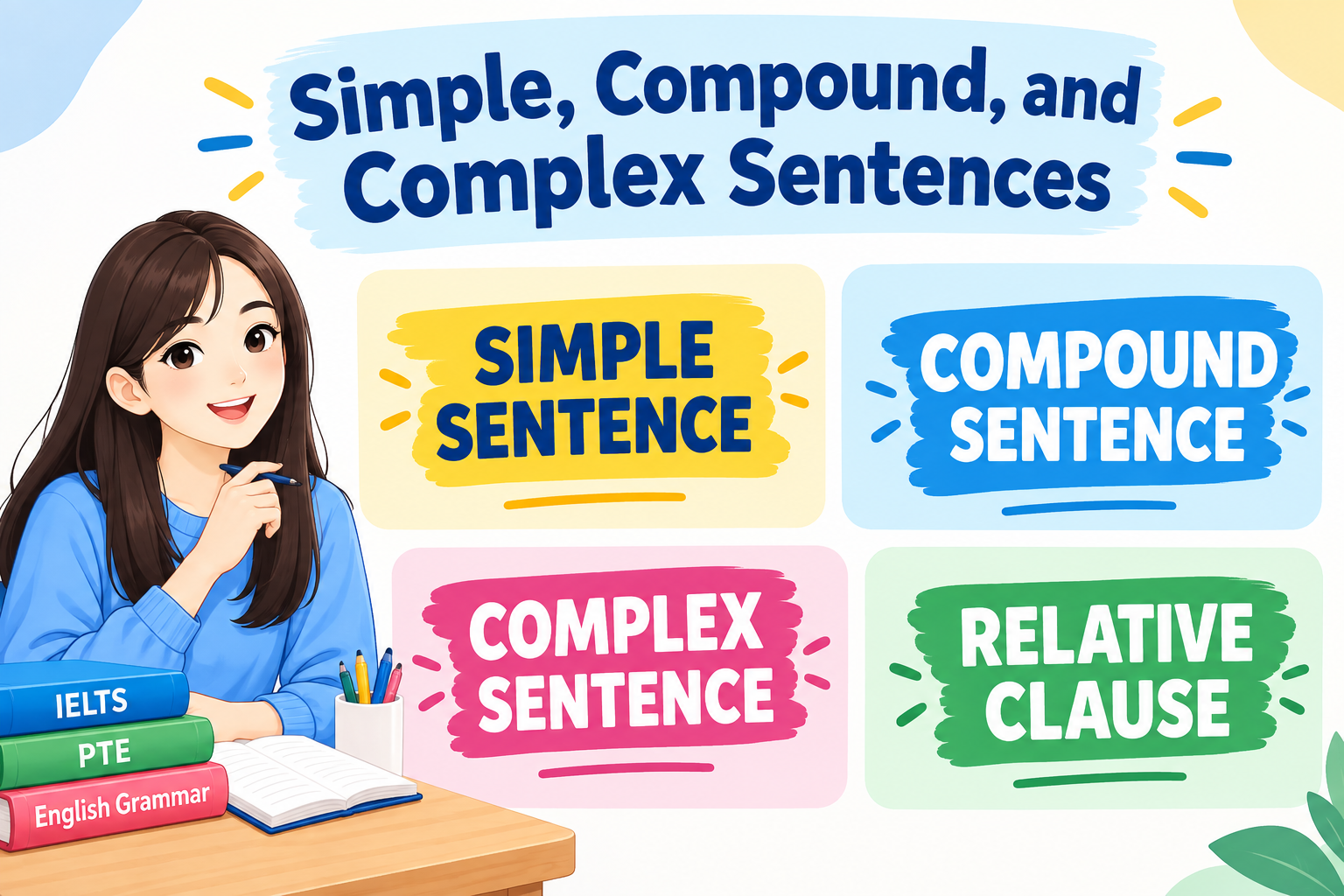

Understanding simple, compound and complex sentences is essential if you want to write clearly and confidently. Whether you are preparing for an English exam, writing an academic essay, or simply trying to improve your everyday English, knowing how sentences are formed can make a big difference.
English sentences can be written in different ways depending on the number of clauses they contain and the relationship between those clauses. Simple, compound, and complex sentences are three important sentence structures that help writers express ideas clearly and connect information effectively.
In this guide, we will explore simple, compound, and complex sentences, including their structures, uses, and examples. We will also look at relative clauses, which can be used to add extra information to sentences.
1. Simple Sentences: Structure, Rules and Examples
A simple sentence expresses one main idea. It contains one independent clause, which means it has a subject and a verb and can stand on its own as a complete sentence.
Basic Structure
Subject + Verb + Object
Examples of Simple Sentences
- Success creates opportunities.
- Solar energy is a form of renewable energy.
- The sun is bright.
- Exercise helps people maintain good health.
- Students study English.
- Regular exercise improves physical fitness.
The important thing to remember is that a simple sentence contains one independent clause. The sentence may have a compound subject or other additional information, but it still presents one main grammatical idea.
When Should You Use Simple Sentences?
Simple sentences are particularly useful when you want to make an important point clearly. They are also helpful when introducing an idea before explaining it in greater detail.
For example:
Education improves people’s lives.
This sentence is short and direct. If you are writing an essay, you can then develop the idea with compound or complex sentences.
2. Compound Sentences: Structure, Rules and Examples
A compound sentence combines two independent clauses. In other words, it joins two complete sentences to create one sentence.
One of the easiest ways to remember the coordinating conjunctions used in compound sentences is FANBOYS.
FANBOYS Means:
- F – For
- A – And
- N – Nor
- B – But
- O – Or
- Y – Yet
- S – So
When a FANBOYS conjunction connects two complete independent clauses, a comma is normally placed before the conjunction.
Examples of Compound Sentences
- Solar energy reduces pollution, and it is a renewable source of energy.
- Junk food is unhealthy, so people should avoid eating it regularly.
- Travelling is a fun activity, yet it can sometimes be dangerous.
- Solar energy is renewable, but fossil fuels are non-renewable.
- You can study at home, or you can attend a classroom course.
Notice that both sides of these sentences can stand independently.
For example:
Solar energy reduces pollution.
It is a renewable source of energy.
When these two complete thoughts are joined with and, they form a compound sentence.
A Common Mistake to Avoid
Do not automatically put a comma before every FANBOYS conjunction. The comma is needed when the conjunction joins two independent clauses.
For example:
I bought apples and oranges.
There is no comma because and is not joining two complete sentences.
3. Complex Sentences: Structure, Rules and Examples
A complex sentence contains one independent clause and at least one dependent clause.
An independent clause can stand alone as a sentence. A dependent clause, however, cannot normally stand alone because it depends on the main clause to complete its meaning.
Complex sentences are especially useful in academic and formal writing because they allow you to show relationships between ideas, such as cause, contrast, time, and condition.
Two Common Structures
Dependent clause + Independent clause
If the government invests in education, it can improve literacy rates.
Independent clause + Dependent clause
The government can improve literacy rates if it invests in education.
When the dependent clause comes first, a comma is generally used before the independent clause.
Common Words Used in Complex Sentences
Comparison and Contrast
- Although
- While
- Whereas
Time
- When
- Before
- After
- While
Conditions
- If
- Unless
Reasons
- Because
- Since
- As
Examples of Complex Sentences
- If the government invests in education, it can improve literacy rates.
- Although it was raining heavily, the children went outside to play.
- Exercise should be done regularly because it helps prevent obesity.
- Unless the government implements new traffic rules, traffic congestion will remain a major issue.
- After the teacher arrived in the classroom, the students became quiet.
Complex sentences allow writers to explain not only what happened, but also why, when, or under what condition it happened.
4. What Is a Relative Clause?
A relative clause gives additional information about a person, place, thing, or idea. It usually comes after the noun it describes.
Relative clauses are often introduced by words such as who, which, that, whose, and where.
Common Relative Words
- Who – generally used for people
- Which – generally used for things
- That – used for people or things in many defining relative clauses
- Whose – shows possession
- Where – refers to places
Examples of Relative Clauses
- The boy who won the race is my friend.
- The car that I bought yesterday is very comfortable.
- Education, which improves our knowledge and skills, is important for everyone.
- The mountain, which we saw from a distance, was covered with snow.
- This is the school where I studied.
- The student whose project won the competition received a prize.
In these examples, the relative clause provides extra information about a noun.
For instance:
The boy who won the race is my friend.
The words who won the race tell us which boy the speaker is talking about.
Defining and Non-Defining Relative Clauses
Relative clauses can generally be divided into defining and non-defining relative clauses.
A defining relative clause gives essential information about the noun. Without it, the meaning may become unclear.
The student who won the competition received a prize.
Here, the relative clause identifies the student.
A non-defining relative clause adds extra information that is not essential to identify the noun. It is usually separated by commas.
My brother, who lives in Kathmandu, is a teacher.
The information about where the brother lives is additional information, so commas are used.
Simple, Compound, Complex, and Relative Clauses: Quick Comparison
| Structure | Main Feature | Example |
|---|---|---|
| Simple sentence | One independent clause | Exercise improves health. |
| Compound sentence | Two independent clauses joined together | Exercise improves health, and it reduces stress. |
| Complex sentence | One independent clause + dependent clause | Exercise improves health because it strengthens the body. |
| Relative clause | Gives information about a noun | Exercise, which improves health, should be done regularly. |
Why Are Simple, Compound, and Complex Sentences Important?
Using only one type of sentence can make your writing repetitive. Strong English writing usually combines different sentence structures.
For example, consider this short paragraph:
Exercise is important. It improves physical health, and it can reduce stress. Although many people are busy, they should make time for regular exercise. People who exercise regularly often feel more energetic.
This paragraph uses simple, compound, complex, and relative-clause structures. As a result, the writing sounds more natural and provides a clearer connection between ideas.
This is particularly useful for essay writing, academic writing, IELTS, school examinations, and general English communication.
Tips for Using Simple, Compound, and Complex Sentences
1. Start with simple sentences
If you are still learning English grammar, begin with clear simple sentences. Make sure your subject and verb agree before trying more complicated structures.
2. Use compound sentences to connect related ideas
When two ideas are closely connected, FANBOYS conjunctions can help you combine them naturally.
3. Use complex sentences to explain relationships
Use words such as because, although, if, when, and unless to show reasons, conditions, contrast, and time.
4. Use relative clauses to add useful details
Relative clauses help you describe nouns without creating several short sentences.
5. Avoid making every sentence complicated
Good writing is not about using the longest or most complicated sentences possible. A mixture of sentence types usually makes writing easier to read.
Final Thoughts
Learning simple, compound, and complex sentences is an important step toward better English writing. A simple sentence helps you express a clear idea, a compound sentence connects two complete thoughts, while a complex sentence shows relationships such as reason, time, contrast, or condition. A relative clause allows you to add more information about a person, place, thing, or idea.
The best way to master these structures is through regular practice. Try writing a few simple sentences first, then combine related ideas using FANBOYS. After that, practise using words such as because, although, if, when, and unless. Finally, add relative clauses using who, which, that, whose, and where.
With consistent practice, you will be able to vary your sentence structures and make your English writing clearer, smoother, and more effective. If you are preparing for IELTS, you can also visit the British Council IELTS website for official test information and preparation resources.
2 thoughts on “Simple, Compound, Complex, and Relative Clauses: Sentence Types in English”